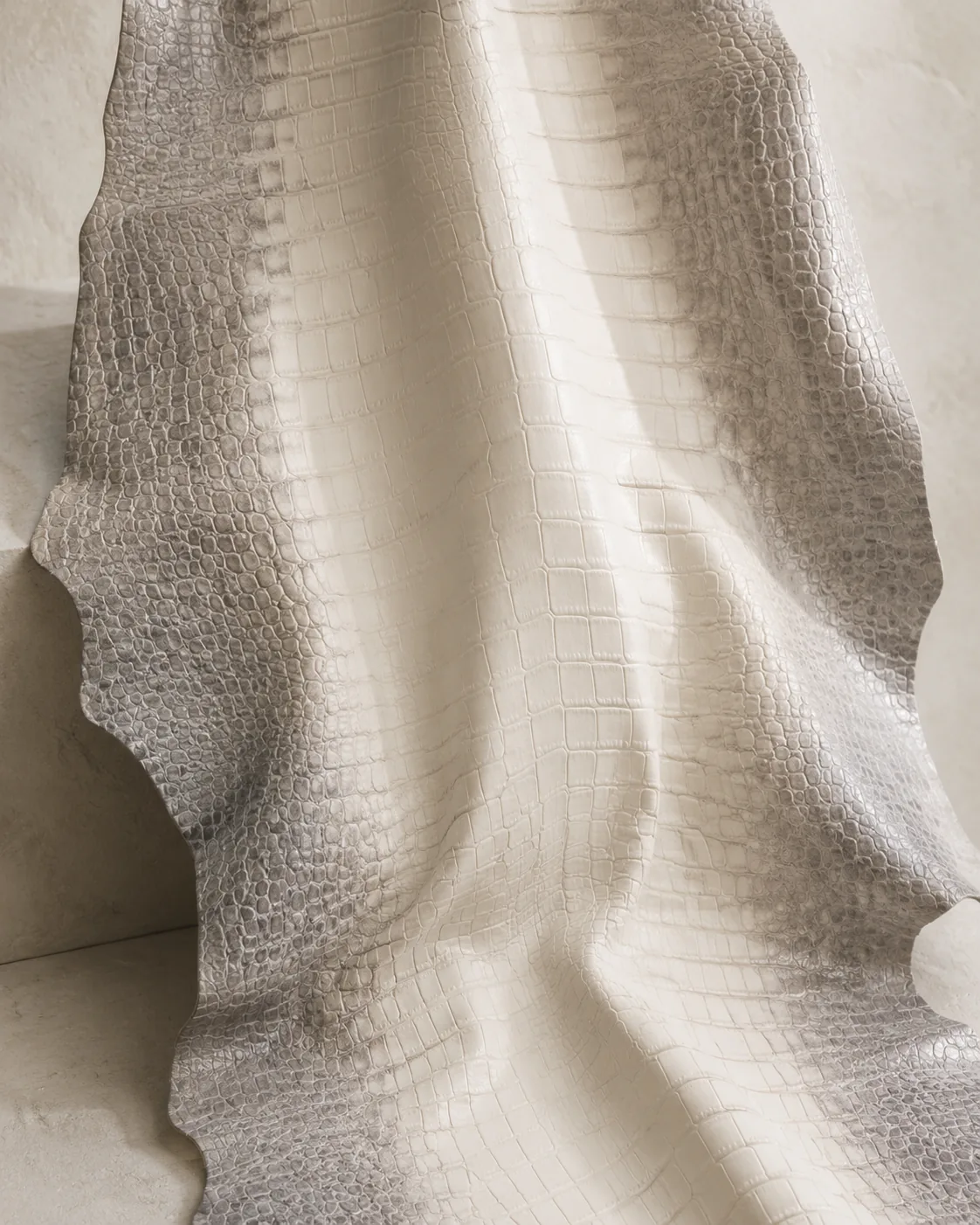
Ask most people what crocodile leather looks like and they will describe something dark — espresso brown, black, oxblood. The Himalayan finish is the opposite, and it is prized precisely because it is the hardest to achieve.
A gradient, not a colour
A Himalayan hide moves from a luminous pearl ivory at the centre of the belly out to soft taupe, then to smoky grey at the flanks. That transition is not printed or stamped. It is the result of bleaching the hide back almost to white and then building colour outward in thin, controlled passes, so the pale centre survives while the edges take on depth.
Because the gradient follows the natural geometry of the individual hide, it lands differently every time. Two straps cut from two hides will share a family resemblance and nothing more. That is the point of the material, and it is why we cut for the gradient rather than against it.
Why pale exotic leather is difficult
Dark dyes hide things. Pale ones do not. Any scar, insect bite, healed injury or uneven scale from the animal's life shows immediately once a hide is taken this light, which means the usable yield from a pale hide is far smaller than from a dark one. A tannery working in ivory discards material that would pass without comment in black.
The same applies at the cutting stage. A strap is a narrow rectangle, and it has to carry a balanced run of scales along its length, with the gradient reading the right way round on the wrist. On most hides, only a limited area satisfies both.
What we cut for
- Balance — scale rows that stay even across the width of the strap rather than drifting diagonally.
- Grain direction — so the pattern runs with the wrist, not across it.
- Transition strength — the clearest available move from white through to grey within the length of one strap.
Scales, and what they tell you
The belly of a crocodilian gives the rectangular, tile-like scales most people picture. They are larger and squarer toward the centre and compress as they approach the flank. A genuine hide shows small irregularities between those tiles — slight size differences, the odd asymmetric corner, a faint follicle mark at a scale junction. Embossed calfskin imitating crocodile does not: its pattern repeats on a fixed interval because it was pressed from a plate.
If you look closely at a Himalayan strap under raking light, the surface is not flat. Each scale sits at a marginally different angle, so the leather appears to change as your wrist moves. That movement is the single hardest thing to fake and the easiest way to tell the material apart.
Finishing
Once cut, a strap is skived down at the edges so it sits flat rather than bulking at the clasp, layered onto a backing, stitched, and then edge-painted in several passes with drying and sanding between each. Edge work is where hand-finished leather separates itself: a burnished, sealed edge resists the lifting and fraying that eventually opens up a raw-cut one.
The whole sequence runs to roughly 28 individual operations across about seven days. Most of that time is waiting — adhesives, edge paint and finishes all need to cure properly, and rushing any of them shortens the life of the strap.
Worth knowing: crocodilian species are listed under CITES, the international convention governing trade in protected species. Legitimate exotic leather moves with documentation, and import rules apply in the UAE as elsewhere. Ask any seller of exotic leather about provenance — including us.